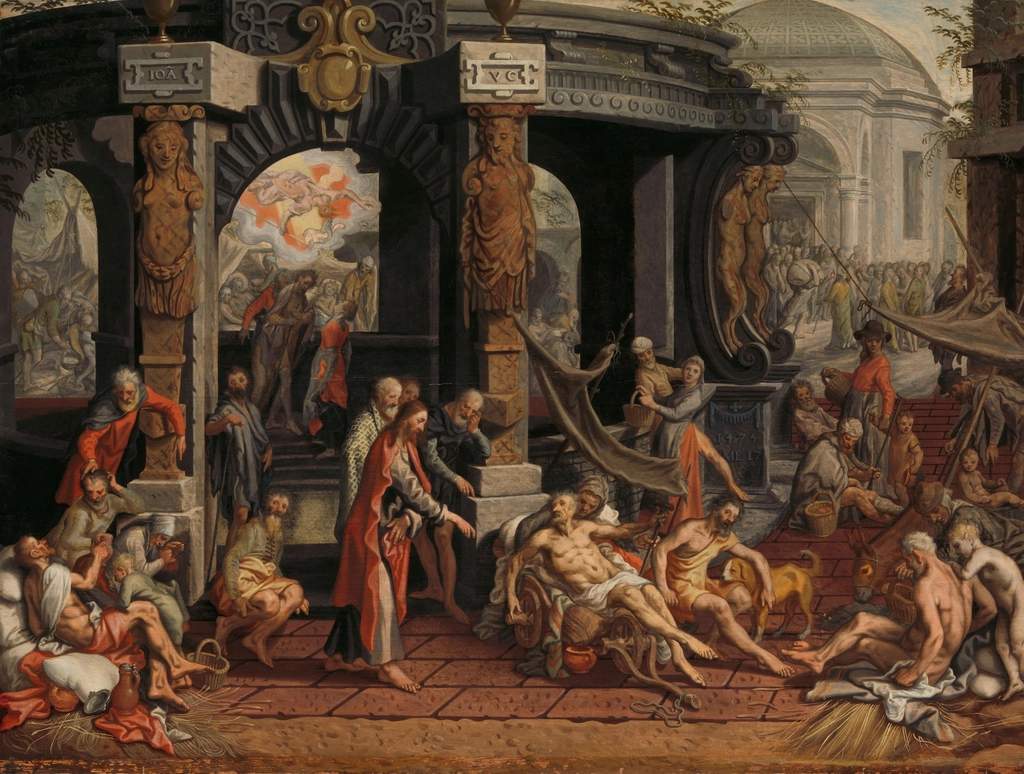

The city of Jerusalem contained numerous pools, and Bethesda was one such site surrounded by five colonnades or porticos. It was associated with healing from early on and is mentioned only once in the Bible in the fifth chapter of the book of John where Jesus healed a paralytic. The gate near which the Pools of Bethesda lie is to the north of the Temple Mount. As this pool was near the mount as well as this gate, it is certain that travelers who were going to worship at the holy site of the temple would pass by the pools. Whether or not for purely superstitious reasons, the pools came to be associated with healing. After some centuries, the pools were forgotten or denied, though not until much later.
The article called “Beth-zatha” in the Baker Encyclopedia of the Bible indicates that there are a number of names traditionally for the Pools of Bethesda. It has been called the Pools of Bethsaida, meaning, “House of Fish,” just like the Bethsaida located near the Sea of Galilee. the Pools of Bezatha, or the Pools of Belzetha. Actually, Beth-zatha means “House of Olives,” according to the article, but it goes on to say that
Recent studies, especially of the Copper Scroll of Qumran Cave 3, make it clear that Bethesda is the correct form among the several variations. Further, it is a dual form which indicates that the site of Bethesda was characterized by two pools. This understanding shows that the older theory that Bethesda meant “house of mercy” is incorrect.
However, Easton’s Bible Dictionary as well as every other source that I studied or referenced for this paper indicates that “Bethesda” means “House of Mercy.” Actually, “Beth Hasda” has the literal meaning of “House of Mercy” as indicated in Donald L. Brake’s book, “Jesus, a Visual History.” However, he goes on and is less than 100% certain that “Bethesda” means “House of Mercy.” He only strongly suggests that that is its meaning. So, it is probably not an issue about which a person can be absolutely certain.
The Pools of Bethesda were thought for some time in recent history to not exist and to be simply a fabrication. Some archeological work had been done in the area by Conrad Schick and Charles Warren in the 1800’s. Then excavations were later begun again by J.M. Rousee and R. de Vaux in the years 1957 to 1962. They believed that this was the location for the Biblical site and wanted to uncover more in order to confirm this.
In the process, “they uncovered a five sided pool with covered colonnades precisely in the area of the Sheep Gate.” There are four criteria for the Pools of Bethesda that are defined in the Gospel of John. They are as follows: 1.) It is located near the Sheep Gate; 2.) The name of the Pool is Bethesda; 3.) It has five porticoes; and 4.) it has on occasion some turbulence in the water.
John writes in John 5:2-9:
Now there is in Jerusalem near the Sheep Gate a pool, which in Aramaic is called Bethesda and which is surrounded by five covered colonnades. Here a great number of disabled people used to lie—the blind, the lame, the paralyzed. One who was there had been an invalid for thirty-eight years. When Jesus saw him lying there and learned that he had been in this condition for a long time, he asked him, “Do you want to get well?”
“Sir,” the invalid replied, “I have no one to help me into the pool when the water is stirred. While I am trying to get in, someone else goes down ahead of me.”
Then Jesus said to him, “Get up! Pick up your mat and walk.” At once the man was cured; he picked up his mat and walked.
While there has not been uncovered any actual signage that would literally indicate that “this site is the pool of Bethesda,” archeologists can be fairly dogmatic that the site in question actually is the Biblical site due to the fact of its location, for one thing, as well as the presence of longstanding tradition suggesting that this is the site of the healing mentioned in the text.
The Sheep gate, was mentioned in Nehemiah 3:1, Nehemiah 3:32, and Nehemiah 12:39. It is believed that this is the gate where the offerings were brought into the temple as worshipers walked to the temple mount. The pools of Bethesda are located near where this gate was located.
However, longstanding tradition of this site as the actual location of the pools of Bethesda reach back to Origen in AD 231. He had said that he actually saw five porches in a double pool exactly as a person would expect. However, it is doubted that Origen actually saw what he says he saw. By the time that the fifth century came around, a church commemorating the event of John 5 was built near the pools. Murphy-O’Conner writes,
The name of the Virgin Mary appears for the first time in the next century; it may have been the title of a second church. How a church might have survived the destructive edict of the Fatimid sultan Hakim in 1009 is a mystery, but one certainly existed at the very beginning of the Crusader occupation. In 1104 Baldwin I committed his repudiated wife, the Armenian princess Arda, to the care of the community of Benedictine nuns who served it, and endowed the convent royally. They erected a small chapel in the middle of the large Byzantine church: a stairway down to the corner of the northern pool permitted pilgrims to venerate the miracle of John 5.
Then between 1131 and 1138, the convent church that existed before that time on this site (churches had come and gone in the intervening years) “was replaced by the beautiful Romanesque Church of St. Anne,” which is still there today.
A portico is defined as “a structure consisting of a roof supported by columns or piers, usually attached to a building as a porch.” The text says that there were five of these. However, with the passing of time and the destruction, a person cannot make out this structure in our modern era.
As to the turbulence in the water described in the text, the pools were really extensions outside of a reservoir which may have fed a mikveh or an otzer. David Graves defines these terms in the following,
An otzer was a reservoir pool connected to a Mikveh by a channel or pipe used to transfer water to the Mikveh, keeping the water in the Mikveh ceremonial [sic] pure through natural flowing “living” water. The disturbance of the water created by the draining of water into the southern pool may be what John describes as the “troubling of the water” that attracted the sick to the pool for healing (John 5:4,7).
Actually, the name “Bethesda” might actually mean, “house of mercy.” This would be an appropriate name for that which feeds a Mikveh, which is a pool of ceremonial cleansing from sin before entering a holy site such as the Temple mount in order to worship. However, even outside of this significance, the pool came to be associated with healing “after AD 135 when Jerusalem was paganized into Aelia Capitolina the sanctuary expanded into a temple; votive offerings of the C2 and C3 AD in gratitude for cures show that it was dedicated to Serapis (Asclepius).” They have in fact found a number of statues of Asclepius in the pool thus connecting this site with the superstitions of the people in this regard.
In fact, this superstition must have come into play in regards to the text found in John 5. The King James Version reads differently. It says the following in verses 3-5:
In these lay a great multitude of impotent folk, of blind, halt, withered, waiting for the moving of the water.
For an angel went down at a certain season into the pool, and troubled the water: whosoever then first after the troubling of the water stepped in was made whole of whatsoever disease he had.
And a certain man was there, which had an infirmity thirty and eight years.
The question then lies in the issue of how the King James Version can mention the moving of the waters as being due to an angel coming down out of Heaven to do so, and whoever stepped in first was cured of his or her ailment. What has happened is that since the King James Version has been produced, older manuscripts classified as the Alexandrian text types have been discovered and are thus more accurate in their copying of the Bible. The King James Version Bible is based on the less ancient copies of the Bible known as the Byzantine texts which formed the basis for the textus receptus as well as other earlier English translations of the Bible.
Apparently, a scribe, in wanting to clarify the issue of why the sick and enfeebled were gathered around the Pools of Bethesda for healing in John 5, inserted a note, possibly in the margin, and over time, this added note came to be copied as part of the original text. It is also possible that the scribe simply made the change to the original text and simply added his note as if it were actually a part of the original copy from which he was doing his work.
Tertullian lived from AD 155 through c. AD 240. This tale is also found in his writing “On Baptism” where he waxes long about the beneficial effects, even in paganism, of water. He then turns and deduces that if pagan religious ablutions are of any help to people, then how much more should the true religion’s ceremonial washings truly be of aide?
Why have we adduced these instances? Lest any think it too hard for belief that a holy angel of God should grant his presence to waters, to temper them to man’s salvation; while the evil angel holds frequent profane commerce with the selfsame element to man’s ruin. If it seems a novelty for an angel to be present in waters, an example of what was to come to pass has forerun. An angel, by his intervention, was wont to stir the pool at Bethsaida. They who were complaining of ill-health used to watch for him; for whoever had been the first to descend into them, after his washing, ceased to complain.
So, it can be seen that as early as Tertullian’s time, it was apparently widely accepted that this folk legend was in fact true. So, by this time, the text of the Bible was apparently seen in this light, but the idea that an angel came down regularly to stir up the waters of the Pools of Bethesda and whoever was quick enough to jump in first was going to get healed is a bit of sad business for those who were too sick to get in fast enough. God would not work that way in healing his people. Unfortunately for the masses of the time of Christ, the Pools of Bethesda came to be understood as a place where such folk legends took place. Jesus, however, did not accept or encourage such beliefs. He simply told the paralytic to rise, pick up his mat and walk.
What a student of the Bible can take away from this site is that the Bible is accurate in its details even if we can point toward certain possible corruptions of the original text such as the Angel stirring the waters. At the same time, this itself is not only rare, but modern readers can know, due to the discovery of earlier manuscripts, that such things are in fact corruptions. In other words, the newer translations do not even indicate this anymore because the modern scholar has better resources. Therefore, the Pools of Bethesda only really give a student of the Bible a greater confidence in the text that exists today and a greater awareness of the detail apparent in the text of the Bible as a whole that it would be accurate about the description of a specific place in Jerusalem that had for years be covered up.


Leave a Reply