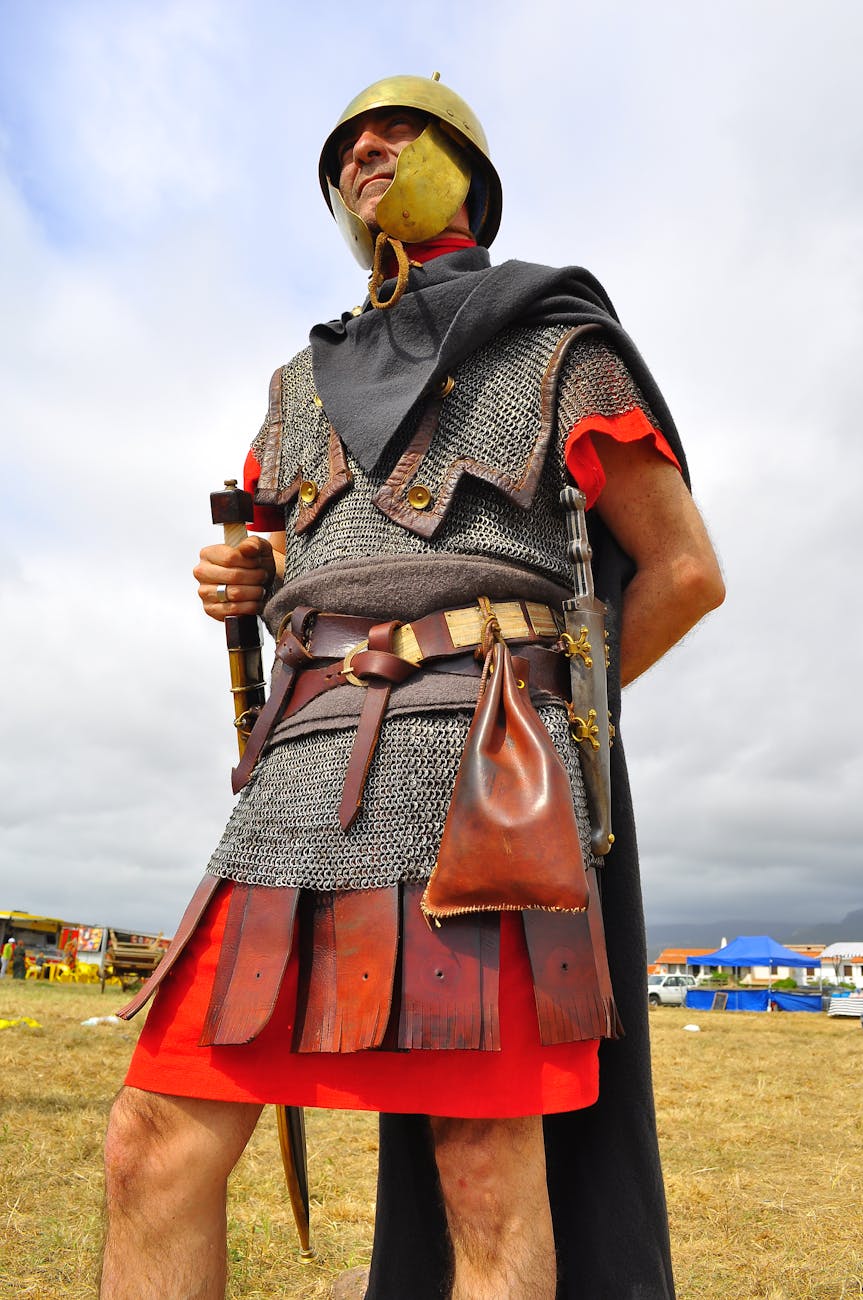
The following is a manuscripted sermon that I composed. Paul calls the Ephesians to be strong in the Lord and to stand against the spiritual forces of evil, taking up the Spirit-supplied resources that God has given to His saints.
- A Call to Arms (vv. 10-13)
- The Source
- The Means
- The Adversary
- The Stand
- The Weapons of Our Warfare (vv. 14-18)
- Truth
- Righteousness
- The Gospel
- Faith
- Salvation
- The Word of God
- Vigilant Prayer
The armor of God is God’s provision for the specific purpose of holy living and glorification of God. The Christian by definition is one who, once being an enemy of God, has been reconciled to God through the sacrifice of His Son. The Christian is one who is no longer an enemy of Christ but a servant and soldier of Christ. He has defected to the army of God through the reconciliation offered through Christ. The Church has lost this view and instead lives as if the believer should look as much like the world as possible in order to ease people into the kingdom. They do not want to look odd or different because that might push people away. Holiness has been thrown out the door and Christian culture has been put in its place as a means of evangelism. There are mountains of books and counselors on how to live life to the fullest and be successful and happy but the thought that the Church is in a spiritual war is non existent.
Here is Ephesians seen backwards: the believer is in a spiritual warfare fighting against the onslaughts and deceiving temptations of the prince of this world. This warfare arises from spirit-filled living in the family and at work which is based on the fact that Christians have been blessed with every spiritual blessing in the heavenlies because of the sovereign grace of God that adopted wretches purely out of love. The contemporary church has rejected the idea that there is any warfare at all. Perhaps this is because she has not experienced the holy and godly living that should characterize the believer who has been purchased with Christ’s blood. Perhaps many in the church have never been redeemed in the first place.
In Ephesians 6:10-18, Paul gives a call to arms – a call to stand against the enemy of our souls. In the first part he defines the seriousness of this call and its consequences. In the latter part he lays out the weaponry of this warfare, enumerating seven essential elements of effective battle-preparedness so that the believer will not be caught off guard or misdirected in the confusion of war.
This epistle is considered as part of the Prison Epistles, written sometime between 60-62 ad. These epistles consist of Ephesians, Colossians, Philemon, and Philippians. “As to the first three,” writes Charles Hodge, “it is expressly stated that they were sent together by Tychicus and Onesimus” (see Eph. 6:21; Col. 4:7-9; Philemon 12). So the authorial context in which Ephesians is written is in Paul’s final imprisonment, and that from Rome no more than two years from his date of execution. His ability to teach and to receive visitors was very liberal at this time as he was under house arrest – not permitted to leave (Phil.1:12-18).
Commentators widely agree that Ephesians was likely a cyclical letter due to the fact that it is not addressed to any particular congregation in the earliest manuscripts nor is there any reference to a specific individual in the church; thus the phrase “who are at Ephesus” was possibly inserted later because of the fact that it may have been sent to Ephesus first. Thus, the original audience possibly consisted of a number of local cities.
At the time that Paul wrote, Ephesus was a center of religious worship and ancient culture, containing the temple of Diana, or Artemis, as well as being a very prominent Roman colony. The worship of Diana had special significance in the lives of the people. Hodge writes,
“With the worship of Diana the practice of sorcery was from the earliest times connected. The ‘Ephesian letters,’ mystical monograms, used as charms or amulets, are spoken of frequently by heathen writers. Ephesus was therefore, the chief seat of necromancy, exorcism, and all forms of magic arts for all Asia.”
The two primary aspects of Ephesus was first that it was Roman and second that it was renowned for its pagan idolatry.
The broad literary structure of the book consists in two parts – that of the resources of the believer in the first three chapters and then the living out of these principles in the final three chapters. In the Old Testament, the saints knew nothing of the indwelling kingdom of God as those who possess the Spirit of God in the New Covenant understand it. The prophets of the Old Testament testified of the coming kingdom of God and the Messiah’s reign on the earth, but when Christ came, they saw a Messiah who came to announce a kingdom that was not of this world. They wanted to wipe away the oppression of the Romans, but Christ came to wipe away the oppression of sin. They sought a throne in Jerusalem; Christ sought a throne in the believer’s heart. With this, Paul could exult in the sufficiency of Christ and his grace in the Christian’s heart. Anyone who is bought with the blood of Christ and sealed with the Holy Spirit as a pledge of eternal life possesses all the resources for obedience to the Lord – there is nothing that holds him back from glorifying God in his life. MacArthur writes,
“The word ‘riches’ is used five times in this letter; ‘grace’ is used twelve times; ‘glory’ eight times; ‘fullness’ or ‘filled’ six times; and the key phrase ‘in Christ’ (or ‘in Him’) some twelve times.”
All these things are in Christ, and anyone who lives with the Spirit of Christ and is seeing the fruits of obedience in his life will encounter spiritual warfare. Paul calls the Christian to arms, reminding him of the nature of the warfare and the resources that he has in Christ. Then he enumerates in vivid portrayal, the weapons that are ready and available for this serious combat.
A Call to Arms (vv.10-13)
Paul has just enumerated different practical aspects of life wherein believers are to honor the Lord. In so doing, he then moves to identify the struggle that, without doubt, will ensue, for all who desire to live godly in Christ Jesus will suffer persecution. “Finally, my bretheren…” Paul says finally, or overall, referring to what he has just written – that the person who has been blessed with every spiritual blessing in the heavenly places in Christ and who is walking worthy of the calling with which he has been called living in the practical daily context of life, must “be strong in the Lord and in the power of His might.” Furthermore, lest anyone shrink back from the demands of the Christian struggle, thinking that such a life is lived according to the flesh, he commands in the Lord to stand.
People approach sanctification in two different ways: some will fall back from the front lines having lost sight of the fact that they are under the indefatigable power of God, and some will, being self-sufficient think themselves able to conquer in their own resources. Both of these are insufficient. In the first instance, it is obvious that despite the fact that the Christian’s heart may burn to be successful in the fight against personal sin and to be used of God in ministry, yet he can only see his own weakness and defeat so he shrinks or falls away because of self-absorption not recognizing the fact that it is by grace that one is saved and by grace that one conquers. The latter individual flies out unprepared and unorganized disregarding the Lord’s armor and most especially humble, unceasing prayer. Neither individual tastes the sweetness of victory in the Lord. The Lord will still win His war, but He will win it without them, if they persist in their own resources.
In Exodus 17, God called the Israelites to combat, but he called Moses to take up his rod and hold it over the army of the Lord. As long as he did this, the Israelites defeated the Amalekites, but when he let it down, the Israelites were thrown back. After the battle, Moses built an alter and called it, “The-Lord-Is-My-Banner.” How many in our congregations or pastors today are raising banners in their own means thinking themselves to be of necessity in the Lord’s work? He will not share His glory with another. Also, how many today are falling into the same ignorance that the Corinthians displayed when they took up the banners of men saying, “ ‘I am of Paul,’ or ‘I am of Apollos,’ or ‘I am of Cephas,’ or [even, divisively] ‘I am of Christ.’ Is Christ divided? Was Paul crucified for you? Or were you baptized in the name of Paul? (1 Cor. 1:12-13).” We should not over-credit our leaders, but Christ is our one banner and we stand firm in no other resource but Jesus Christ. So, Paul writes, “be strong in the Lord and in the power of His might.” This is none other than the might that he has just proclaimed in the preceding chapters:
“For this reason I bow my knees to the Father of our Lord Jesus Christ, from whom the whole family in heaven and earth is named, that He would grant you, according to the riches of His glory, to be strengthened with might through His Spirit in the inner man, That Christ may dwell in your hearts through faith; that you, being rooted and grounded in love, may be able to comprehend with all the saints what is the width and length and depth and height – to know the love of Christ which passes knowledge; that you may be filled with all the fullness of God (Ephesians 3:14-19).”
Paul now identifies the means of our standing firm saying in verse 11:
“Put on the whole armor of God, that you may be able to stand against the wiles of the Devil.” God, in His goodness, has provided the means of our victory in His weaponry that we can make use of in the midst of strife. Enduō, “put on” has the implication of permanence. The armor of God is not something that you take off and put back on repeatedly but it is something that the Christian possesses through all of life. This is in order to stand against the wiles of the devil. MacArthur further points out that “to stand” (from histēmi) had, “when used in a military sense,…the idea of holding a critical position while under attack. The intent of the exhortation is not unlike that of our Lord to the embattled church at Thyatira, whom He commanded, ‘hold fast until I come’ (Rev. 2:25).” So, the soldier is to firmly stand his ground in the face of the wiles and schemes of the adversary, whom Paul identifies as Satan.
Paul explains his reasoning:
“For we do not wrestle against flesh and blood, but against principalities, against powers, against the rulers of the darkness of this age, against spiritual hosts of wickedness in the heavenly places. (v.12)”
Paul shows that we do not struggle against men but against spiritual hosts that sling their arrows at us from a distance veiled in whatever natural visage they may be. So we fight against an unseen enemy. Calvin writes:
“Let us remember this when the injurious treatment of others provokes us to revenge. Our natural disposition would lead us to direct all our exertions against the men themselves; but this foolish desire will be restrained by the consideration that the men who annoy us are nothing more than darts thrown by the hand of Satan. While we are employed in destroying those darts, we lay ourselves open to be wounded on all sides. To wrestle with flesh and blood will not only be useless, but highly pernicious.”
We are at odds with the spiritual realm not the physical. Paul reemphasizes this again and again with his repeated use of “against.”
Having identified the source, the means, and the adversary, in verse 13, Paul reiterates that the believers must put on the whole armor of God being prepared for the evil day. Again, the point of the passage is that believers are able to stand against the devil using the defenses of the Lord. The point is not that believers are going out and pursuing or attacking Satan, but rather Satan is attacking the saints. This puts the Christian’s focus still on knowing and obeying Christ never on trying to defeat Satan.
The Weapons of Our Warfare (6:14-18)
Paul first identifies the waist being girded with the truth. This was exemplified in the ancient belt that cinched up the four corners of the garment. This was done before battle so that the soldier’s legs were not caught up in the garment. To be girded with truth is to have a ready and prepared mind that cannot be tripped up with the foolishness of this world, the distractions of sinfulness, or anything that otherwise may hinder the believer in his resolve to live the godly life that Paul has expounded on in the previous chapters.
1 Peter 1:13-16 says,
“Therefore gird up the loins of your mind, be sober, and rest your hope fully upon the grace that is to be brought to you at the revelation of Jesus Christ; as obedient children, not conforming yourselves to the former lusts, as in your ignorance; but as He who called you is holy, you also be holy in all your conduct, because it is written, ‘Be holy, for I am holy.’ ”
MacArthur comments:
“Alētheia (truth) basically refers to the content of that which is true. The content of God’s truth is absolutely essential for the believer in his battle against the schemes of Satan….But Alētheia (truth) can also refer to the attitude of truthfulness. It represents not only the accuracy of specific truths but the quality of truthfulness. That seems to be the primary meaning of what Paul has in mind here. The Christian is to gird himself in an attitude of total truthfulness. To be girded…with truth therefore shows an attitude of readiness and of genuine commitment. It is the mark of a sincere believer who forsakes hypocrisy and sham.”
John Calvin wrote that Paul has “sincerity of mind” in view. “Our attention is thus directed to the fountain of all sincerity; for the purity of the gospel ought to remove from our minds all guile, and from our hearts all hypocrisy.” The believer is first of all and preeminently to have a mind that is characterized as having spiritual “focus.” In other words, the Christian’s single effort in all of life is the sincere, unhindered and unadulterated passion to be holy. This holiness is not simply holiness for its own sake but a holiness that is God-focused in its effort to “walk worthy of the calling with which [we] have been called (4:1)” This calling is that which God called us to in chapter one “as adopted children of God.”
The second piece of armor that the apostle mentions is the breast-plate of righteousness. However, the question is whether the righteousness that the apostle is speaking of is the righteousness of God or the practical righteousness of sanctification. Some commentators argue that this is the righteousness of Christ that is imputed by faith, for there was never a righteousness of man that was the basis for anything protective:
“Many say that it is our own righteousness, integrity, or rectitude of mind. But this is no protection. It cannot resist the accusations of conscience, the whispers of despondency, the power of temptation, much less the severity of the law, or the assaults of Satan. What Paul desired for himself was not to have on his own righteousness, but the righteousness which is of God by faith…”
This is true, yet Paul is not speaking to pagans but to Christians. Paul called the Romans in chapter thirteen to “put on the Lord Jesus Christ, and make no provision for the flesh, to fulfill its lusts. (Romans 13:14)” Likewise here the apostle, once again speaking to Christians, says that they must put on the breastplate of righteousness. Furthermore, it should be pointed out that while Christians do not stand on their own righteousness but the righteousness forensically imputed to them by the blood of Christ, yet this is not the only righteousness that grace imparts to the soul. The very point of this book is that as Christians the Ephesians posses every spiritual blessing in Christ. Therefore, Paul can command them to be being kept filled with the Holy Spirit (5:18). It is therefore just as much an act of grace that gives the believer the protection of practical righteousness as that of the forensic; there is thus no need to fear the implications of personal righteousness as a weak shield against Satan, for it too is a work of grace arising from faith (Phil. 2:13). James Montgomery Boice comments:
“In this context Paul is urging those who already are Christians to ‘put on’ God’s armor. If they are Christians, they have already been clothed with God’s righteousness in the first sense. Therefore the only thing they can put on is practical holiness expressed in righteous thoughts and deeds.”
Many Christians today are so easily turned upside down emotionally over a circumstance or people that are making life difficult. It is very often because they lack the practical inner righteousness that protects them from the onslaughts of Satan. MacArthur writes:
“Many, if not most, of the emotional and relational problems Christians experience are caused by lack of personal holiness. Many of our disappointments and discouragements do not come from circumstances from other people but from our own unconfessed and uncleansed sin. And when circumstances and other people do manage to rob us of happiness, it is because we are unprotected by the armor of a holy life.”
So it is that Paul commands the Ephesians to put on a firm and thick plate of personal holiness that will protect their vital spiritual life from the darts and piercings of Satan’s schemes.
The third piece is that of the feet being shod with the preparation of the gospel of peace. There are once again basically two views that arise as to the nature of this spiritual foot-gear. One is that it is the preparedness to be carrying about the gospel proclaiming it wherever that person goes. Boice says,
“In my judgment the emphasis falls upon readiness to make the gospel known. Any Christian already knows the gospel; he would not be a Christian if he did not. So this must go beyond mere knowledge and approbation. It must involve readiness to share the good news with others. Moreover, Paul links the gospel to the soldier’s boots or sandals. Shoes carry us from place to place, and it is as we go from place to place that we are to be ready to speak about Jesus.”
However, this is not consistent with the text as this is not about ministry but about personal warfare nor, more importantly, about traveling around but about standing firm against the schemes of Satan. Charles Hodge writes,
“The simplest interpretation and that best suited to the context, is that εύαγγελίου is the genitive of the source, and the sense is, ‘Your feet shod with the alacrity which the Gospel of peace gives.’ As the Gospel secures our peace with God, and gives the assurance of his favour, it produces that joyful alacrity of mind which is essential to success in the spiritual conflict. All doubt tends to weakness, and despair is death.”
When Christians stand in the preparation of the Gospel of peace, they posses the assurance that if God is on their side, no man or devil can take away that position in which they stand, which is in grace and not on their own feet. The Gospel alone can bring about the assurance of a person’s success against spiritual onslaughts. This is the reason why Christians must preach the Gospel to themselves having the truth of God’s grace continually in their minds: “For by grace you have been saved through faith, and that not of yourselves; it is a gift of God, not of works lest anyone should boast (2:8-9).”
In verse sixteen, there is a transition as Paul says “above all” or “in addition to all (NASB).” This introduces the following three pieces that include the shield of faith, the helmet of salvation and the sword of the spirit. The shield of which Paul speaks comes from the Greek, thureos that refers to a broad and tall shield that would be utilized in the Alexandrian phalanx formation. One of the missiles that might be hurled was an arrow dipped in pitch and lit just before release. The flaming projectile would not only pierce flesh but would send burning and boiling spatters of pitch for several feet inflicting wounds on the surrounding troops and ruining their protective gear. These fiery darts refer graphically to temptations that the devil slings at the Christian on a daily basis. These include the lusts and desires of the flesh and of the mind as Paul pointed out in 2:3. Nothing but faith can quench and shield against them – faith in a sovereign and gracious God who works all things according to the council of His will. 1 Corinthians 10:13 says,
“No temptation has overtaken you except such as is common to man; but God is faithful who will not allow you to be tempted beyond what you are able, but with the temptation will also provide a way of escape, that you may be able to bear it.”
Thus, the Chirstian should never be discouraged or disheartened in the face of Satan’s fiery missiles. Temptations to lust, anger, pride, depression, loneliness, fear, or other forms of idolatry are not only overcome by sincere trust in God but are actually turned into good (Romans 8:28).
Then Paul identifies the helmet of salvation. The helmet of the soldier was there to defend against the broad sword which would be used to split the opponent’s skull or to slice the head from off his body. The helmet of salvation is the believer’s confidence in the saving work of God. This is not the initial work of salvation in the heart of the individual but the confidence of future salvation when the Christian will obtain glory. Boice writes,
“The helmet of salvation could mean merely that we are saved; that would make sense. But in 1 Thessalonians 5:8 Paul speaks of putting on ‘the hope of salvation as a helmet,’ and if that is what he is thinking of here, then he is looking to our destiny rather than our present state. He is saying that our anticipation of that end will protect our heads in the heat (and often confusion) of the battle.”
This defends against the attack of Satan to discourage the soldier with doubts about the usefulness of his work, discouragement over the struggle of everyday life or a myriad of other things that might make him give up hope or doubt that life has much meaning.
Lastly, Paul speaks of the sword of the Spirit which is the Word of God. This is our only offensive weapon in battling all the schemes of Satan that attack us. It refers to a short sword, a machaira, that is used for close combat always kept at the side and for ready use. Hebrews 4:12 says,
“For the Word of God is living and powerful, and sharper than any two-edged sword, piercing even to the division of soul and spirit, and of joints and marrow, and is a discerner of the thoughts and intents of the heart.”
The Word of God is not a broad-sword to be wielded as if to hack away at the enemy but rather the idea is that it is to be used with deadly and swift precision. “Word” is not the Greek logos but rhēma which refers to a word or a phrase. Therefore, the idea that the Apostle conveys is not that of the whole of Scripture but of the specific parts used with precision in certain and definite applications against Satan. The sword of God’s Word is not to be taken lightly or disregarded. That man who by consistent and daily discipline remains steadfast in study and meditation on the word of God shall be armed with a deadly weapon which the gates of Hades cannot destroy.
Psalm 19 exalts the glory of God’s revelation in two parts. In the second part, the Psalmist exalts God in proclaiming the excellencies of His word saying of its nature that it is perfect, sure, right, pure, clean, true and righteous, and more desirable than anything that this world offers. Its effects are that it converts the soul, makes wise the simple, rejoices the heart, and enlightens the eyes. The Scripture is all-sufficient, infallible and inerrant. 2 Peter 1:20-21 shows God spoke through men as His means to produce the perfect word. 2 Timothy 3:16 reveals that the Scripture is Theopneustos, “breathed-out” by God.
This all-sufficient weapon is to be applied specifically and kept ready always. To neglect it is to lose the battle before it has begun. MacArthur writes,
“No believer has excuse for not knowing and understanding God’s Word. Every believer has God’s own Holy Spirit within Him as his own divine teacher of God’s divine Word. Our only task is to submit to His instruction by studying the Word with sincerity and commitment. We cannot plead ignorance or inability, only disinterest and neglect.”
John Calvin comments,
“If the word of God shall have its efficacy upon us through faith, we shall be more than sufficiently armed both for opposing the enemy and for putting him to flight. And what shall we say of those who take from a Christian people the word of God? Do they not rob them of the necessary armour, and leave them to perish without a struggle? There is no man of any rank who is not bound to be a soldier of Christ. But if we enter the field unarmed, if we want our sword, how shall we sustain that character?”
The contemporary church is leaving the Word of God neglected and to rust in its proverbial sheath – the hearts of Christians and especially those of pastors. If God’s people survive Satan’s schemes they can only do that by using God’s words not whatever is hip on social media.
Paul adds in verse eighteen,
“…Praying always with all prayer and supplication in the Spirit, being watchful to this end with all perseverance and supplication for all the saints.”
So Paul places prayer as an ever vigilant effort and necessity in spiritual warfare. Overall, to these things that he has just enumerated as essential weapons in the spiritual warfare, Paul adds prayer. It is to be done always never neglecting it.
The truth that screams from these pages is that the Christian is engaged in a spiritual battle for the glory of God. The demands and warnings of this passage are a serious call in the face of the frivolity and apathy that characterizes the current attitude of the church. We are enveloped in a battle for the truth, and in this onslaught we are more concerned with soft sermons and seeker-friendliness than the glory of the God to whom every redeemed Christian owes his eternity. Christ is blasphemed by the hypocrisy of people who live in open rebellion to God as LGBTQIA+. Adulterous pastors are “forgiven” and restored to the ministry after committing sexual sin; sermons consist of cute “practical” illustrations, Evangelism is swallowed up in a cultural bent that is no more than an excuse for ungodliness.
The truth is that Christians are in an all out war against a world system that proclaims that truth no longer exists. Post-modernism has killed the idea that truth is antithetical. Truth has been redefined as relative; the Bible is an instrument that people use to create or illustrate their own ideas subjectively.
Real meaning and real value is now defined in terms of experience. It is what a person experiences that is real or true. Truth is defined as that by which a person chooses to existentially define himself. The Bible is passed around a discussion table for people to talk about how it has inspired their own thinking while “Bible exposition” is neglected. May God chasten us for how we have forsaken Him for lies and illusions. Christian culture should be thrown out the door and true evangelism put in its place; political activism must be rejected and true holiness lived in an uncompromising fashion; story-telling must be shunned and verse-by-verse Bible exposition and explanation enacted. The armor of God demonstrates the resources that God has blessed his Church with for holiness and uncompromising living in a deceptive world-system governed by the prince of the powers of the air. How will you live?
Bibliography
Boice, James Montgomery. Ephesians an Expositional Commentary. Baker Books,
Grand Rapids, 1997
Calvin, John. Commentaries on the Epistles of Paul to the Galatians and Ephesians.
Trans. William Pringle. Grand Rapids, Michigan: Baker Book House, 1979
Hodge, Charles. Commentary on the Epistle to the Ephesians. Grand Rapids, Michigan:
WM. B. Eerdmans Publishing Co., 1954.
MacArthur, John. The MacArthur Bible Handbook Nashville, TN: Thomas Nelson
Publishers, 2003.
__________The MacArthur New Testament Commentary Ephesians Chicago, Ill.: Moody
Bible Institute, 1986.






Leave a Reply