I learned about this some years ago while going through Dr. Heath Lambert’s book called, Finally Free, which shows all the more reason to read it because it is about much more than what it would seem. The following very simple explanation of John 6 is based on that book. I don’t follow Dr. Lambert below word for word from the book, but the whole idea for this blog post came from his very simple and profound explanation of that passage in chapter 9 of his wonderful and timely book. I highly recommend it.
Incidentally, John 6 is not at all about the eucharist or communion. Many religions and some denominations take this passage to indicate implied justification for some special kind of view about communion, especially where Jesus commands the crowds to eat His flesh and drink His blood. But not only is the story in John 6 taking place before anyone would have any experience with communion [It hadn’t been instituted yet, so it wouldn’t have been received that way by the crowds], but Jesus was simply correcting the misplaced and very dense crowd who were listening to Him yet not understanding Him. It isn’t hard to understand it really at all. We just need a little bit of context. And in Hermeneutics, context is king.
The Story as a Whole
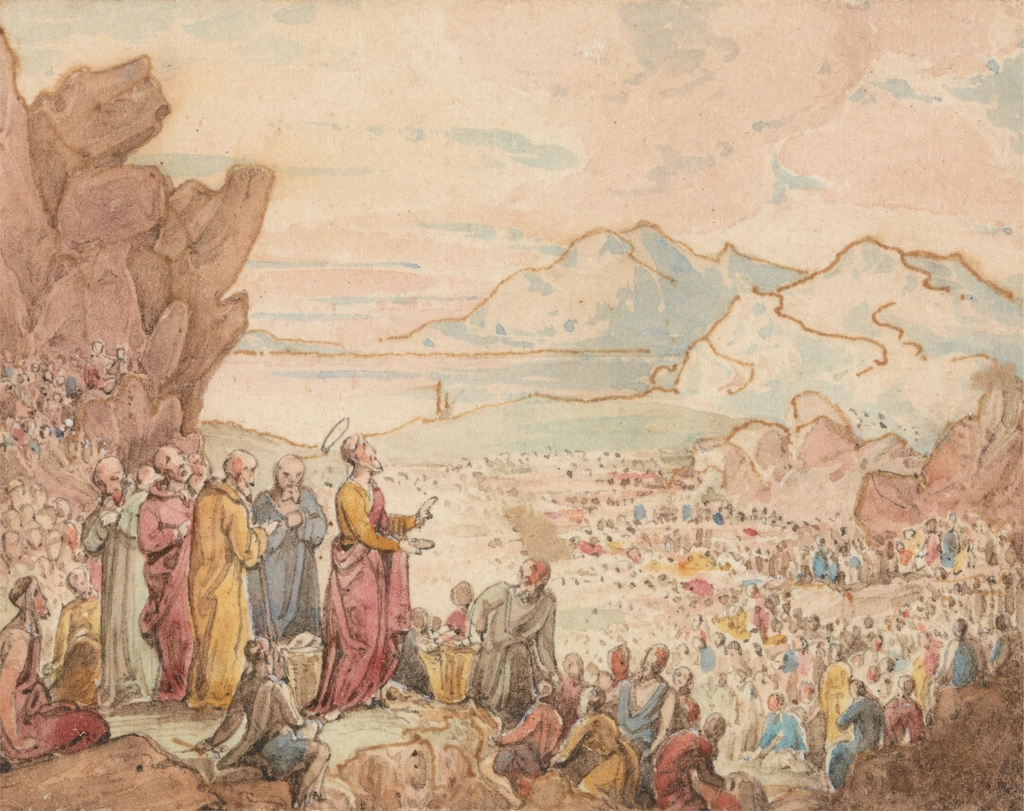
In John 6, Jesus feeds the five thousand, and then he crosses over the Sea of Galilee whereat, on the other side, the crowd found him and asked Him eagerly, “when did you get here?” in verse 25. Jesus answered discerningly and says below:
“Truly, truly, I say to you, you are seeking me, not because you saw signs, but because you ate your fill of the loaves. Do not work for the food that perishes, but for the food that endures to eternal life, which the Son of Man will give to you. For on him God the Father has set his seal.”
— John 6:26-27
This initial comment by Jesus indicates that the crowd was asking about Him not because they were interested in Him personally but because they wanted more bread and fish after the feeding of the five thousand just verses prior. Jesus told them they should not work for the food that parishes but for the food of eternal life. This is key to the rest of the narrative. And Jesus says this is the work of God that they should prioritize. “Then they said to him, ‘What must we do, to be doing the works of God?’” (John 6:28).
Jesus then elaborated to them that the work of God was that “you believe in him whom he has sent (John 6:29).” And as if that wasn’t enough for them to get at what Jesus was suggesting, they asked Him for a sign, apparently another sign involving food! They have just seen Him feed the five thousand, and now they want more. They asked Him:
“…Then what sign do you do, that we may see and believe you? What work do you perform? Our fathers ate the manna in the wilderness; as it is written, ‘He gave them bread from heaven to eat (John 6:30-31).’”
Jesus keeps redirecting them towards Himself. His point is repeatedly that they value Jesus Himself, and the crowd keeps going after more bread. “Jesus then said to them, ‘Truly, truly, I say to you, it was not Moses who gave you the bread from heaven, but my Father gives you the true bread from heaven. For the bread of God is he who comes down from heaven and gives life to the world (John 6:32-33).’” The whole point here is that “you guys still want more bread?” “I am the bread of God who came down and is giving my life for the world.” But they keep missing the point. The point is Jesus, not their bellies. But they said to him, “Sir, give us this bread (still thinking of edible bread) always (John 6:34).’”
Jesus simply repeats more profoundly to them and completely contrary to their desire: “I am the bread of life; whoever comes to me shall not hunger, and whoever believes in me shall never thirst (John 6:35).’”
And this is how dense the crowd is in fact. They profoundly miss the point, and by the end of this conversation, they are offended by this “hard saying.” But Jesus is speaking around their only desire that is for more food. He is redirecting them. He is saying for them to stop worrying about taking bread into their stomachs and rather take Him in while He is with them!
And it is not hard to see how this would be the case even today. Congregants can’t wait to get to the potluck after hopefully a short sermon. Employees at companies can’t wait for the free pizza. It seems that so often, people even with the abundance of modern convenience and entertainment can’t get around satisfying their cravings for more of whatever they want. They are often complaining when the CEO doesn’t reward them with a “proper bonus.” People are naturally and incredibly dense and self-centered. Jesus continued:
40 For my Father’s will is that everyone who looks to the Son and believes in him shall have eternal life, and I will raise them up at the last day.”
41 At this the Jews there began to grumble about him because he said, “I am the bread that came down from heaven.” 42 They said, “Is this not Jesus, the son of Joseph, whose father and mother we know? How can he now say, ‘I came down from heaven’?”
43 “Stop grumbling among yourselves,” Jesus answered. 44 “No one can come to me unless the Father who sent me draws them, and I will raise them up at the last day. 45 It is written in the Prophets: ‘They will all be taught by God.’[d] Everyone who has heard the Father and learned from him comes to me. 46 No one has seen the Father except the one who is from God; only he has seen the Father.47 Very truly I tell you, the one who believes has eternal life. 48 I am the bread of life.49 Your ancestors ate the manna in the wilderness, yet they died. 50 But here is the bread that comes down from heaven, which anyone may eat and not die. 51 I am the living bread that came down from heaven. Whoever eats this bread will live forever. This bread is my flesh, which I will give for the life of the world.”
52 Then the Jews began to argue sharply among themselves, “How can this man give us his flesh to eat?”
53 Jesus said to them, “Very truly I tell you, unless you eat the flesh of the Son of Man and drink his blood, you have no life in you.54 Whoever eats my flesh and drinks my blood has eternal life, and I will raise them up at the last day. 55 For my flesh is real food and my blood is real drink. 56 Whoever eats my flesh and drinks my blood remains in me, and I in them. 57 Just as the living Father sent me and I live because of the Father, so the one who feeds on me will live because of me.58 This is the bread that came down from heaven. Your ancestors ate manna and died, but whoever feeds on this bread will live forever.” 59 He said this while teaching in the synagogue in Capernaum.
John 6:40-59 – New International Version
Jesus is taunting their disbelief! The more they grumble, the more vivid his harsh words become. He would later elaborate on what it means to truly abide in Him while speaking to his disciples privately in John 15:
If you abide in me, and my words abide in you, ask whatever you wish, and it will be done for you. By this my Father is glorified, that you bear much fruit and so prove to be my disciples. As the Father has loved me, so have I loved you. Abide in my love. If you keep my commandments, you will abide in my love, just as I have kept my Father’s commandments and abide in his love. These things I have spoken to you, that my joy may be in you, and that your joy may be full (John 15:7-11).
Jesus wants us to worship Him. He wants us to find our entire satisfaction in knowing Him and abiding in Him as the branch in the vine. We are to produce fruits in keeping with a deep relationship with Jesus personally. In this sense, religion is entirely about relationship. True faith is abiding in Jesus and that means keeping His commandments out of love. It is as if, in the negative sense, we would struggle to disobey Him because of the incredible love we have for Jesus Himself. That is the goal of a relationship with Christ. In order to know Him, we believe Him, and believing Him means loving Him and having a relationship with Him that causes us to be sustained by His life rather than the things this world offers.






Leave a Reply