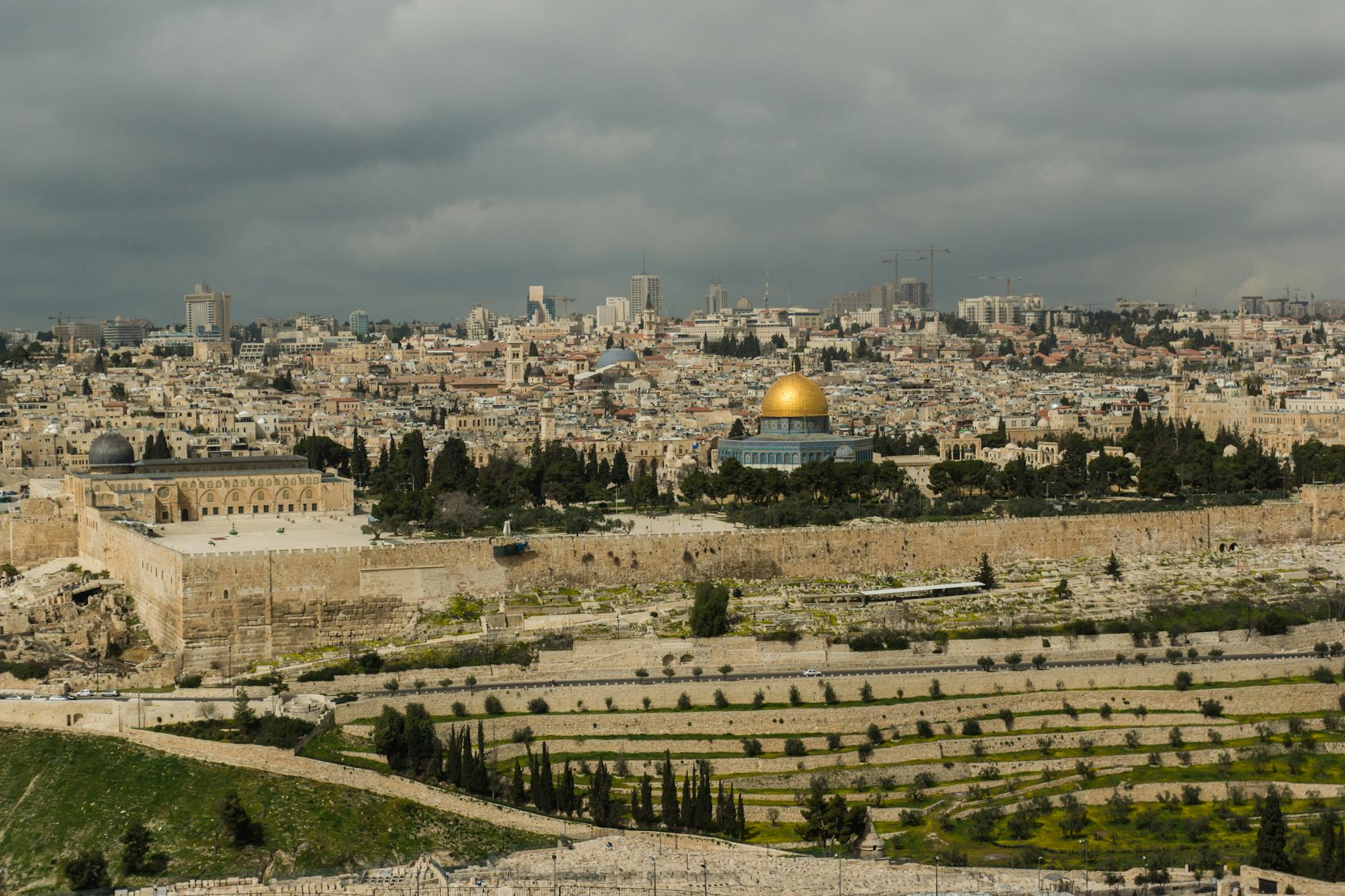
The Old Testament refers to “The Day of the Lord,” “The Day of the Lord’s Judgement,” “The Day of the Lord’s Anger,” “The Day of the Lord’s Wrath,” and “The Great and Terrible Day of the Lord.” The OT speaks of this day as a time when Yahweh will judge the nations (Is. 2:10-21) and punish Israel (Zeph. 1:4), and He will come as a God of terrible war to all those who have dishonored Him. There will also be a resurrection of the dead alongside the living (Dan. 7:9-10). The New Testament speaks of the Day of judgement as accompanying the return of Jesus the Messiah (Acts 10:42; 2 Tim. 4:1). It is referred to as the Day of the Lord Jesus (1 Cor. 1:8; 5:5) Jesus compares this day to the judgement of Sodom and Gomorrah (Matt. 10:15; 11:24). However, 1 John 4:17 says that those who have repented and turned to Jesus do not need to fear this day.
Timing of the Day of the Lord
The Day of the Lord is not necessarily tied to a specific time. For example, “the day of the Lord” was spoken of in a past tense in Lamentations 2:1, which describes the fall of Jerusalem. Joel 1:15 describes a then present event as “the day of the Lord.” Many dispensational theologians seek to parse out different events connected with the different phrases found in the NT such as “day of Christ Jesus” (Phil. 1:6), “Day of the Lord” (1 Cor. 5:5), “Day of Christ” (Phil. 1:10), “day of judgement” (1 John 4:17), etc. However, we do not need to overdo the amount of analysis given to parsing out these different descriptions into separate events. These are referring to the same event.
Many prophets tied the day of the Lord to the punishment and judgement of the nations surrounding Israel. These “day of the Lord” occurrences did happen in ancient times. So, the day of the Lord was also considered fulfilled in some limited sense even in OT times. As an additional example of this, a person could also look at Joel 2:28-32 and its quotation in the NT as well. How did the Apostles view it?
Some suggest that Joel 2 is simply not fulfilled at all. Others believe that Joel 2 is completely fulfilled by Pentecost as the church is seen as the receiver of those prophecies. I believe that it is best to have a partial view. I believe that this more accurately maintains the truths in both Joel 2 and Acts 2 at Pentecost and going forward.
Joel 2:28-32
The significance of the text in Joel is that in the day of the Lord, or Yahweh, the Spirit will be poured out like water on the people of Israel. The Spirit of the Lord will be poured out, and the people will see visions and dream dreams and so forth. In other words, they will receive prophetic gifts. There are other texts in the OT that refer to the day of the Lord in similar fashion except that the gift of prophecy is not in focus. In Ezekiel, for example, the day of the Lord brings in a time when the people return in faith and full obedience to the Lord. At which time, He will give them a new heart and put a new Spirit within them.
However, the point of this passage is that the people of Israel will be given the Spirit of Yahweh, and they will prophesy and dream dreams and so on. Therefore, there is a slightly different emphasis here. This prophecy would be partially fulfilled in the coming of the Spirit on the new church in Jerusalem. The famous example is the day of Pentecost where all the disciples spoke in tongues. But this is the near view aspect. I will also explain why Joel 2 is only partially fulfilled by it.
The far view aspect of this passage is that this will occur on the day of the Lord which is the second coming of Jesus. The Day of Pentecost is only the hint of these things being fulfilled. The Lord will call back His people, Israel, to obedience as a nation in the end times as seen in Revelation. Peter begins his Pentecost sermon by quoting Joel 2:28–32 in its entirety (Acts 2:16–21).
However, the immediate context of Joel 2 informs us that there will be signs in the heavens that the Lord is coming back. There will be intense cosmic anomalies in the heavens with the sun and the moon. There will be judgment and death, but among the survivors will be those whom the Lord will call back to Himself. He will bring all this to pass. If you take all this in Joel 2 into account, then the Day of the Lord cannot be fulfilled in a time that we have yet seen in history because the Lord has not brought down such signs at one time and brought catastrophe that resulted in the nation of Israel being saved. This is ultimately fulfilled in the end times as described in Revelation.
Michael Vlach adds:
The Lord’s pouring out of His Holy Spirit upon His people was fulfilled with the events of Acts 2. So, too, all who called on the Lord were saved. Thus, what began and ended Peter’s quotation of Joel was fulfilled. Not fulfilled, though, were great signs in the sky and earth, and the cosmic signs involving the sun and the moon. These Day of the Lord events await future fulfillment. In 2 Thessalonians 2, Paul said the Day of the Lord had not started yet since the apostasy and the revealing of the man of lawlessness had not yet happened (2:1–4). Peter, himself, argued that the Day of the Lord is a future event: “But the day of the Lord will come like a thief” (2 Pet. 3:10a). This is significant since Peter quoted Joel 2 in Acts 2. If decades later Peter viewed the Day of the Lord as future, this reveals he did not believe the Day of the Lord was fulfilled with the events of Acts 2.
Also, in Acts 1:7 Jesus stated, “It is not for you to know times or epochs which the Father has fixed by His own authority.” Since Jesus said the timing of future events could not be known at this time, perhaps Peter believed the Day of the Lord events could be unfolding soon. But Jesus’ words did not demand that the Day of the Lord was already occurring. So while the Holy Spirit had been poured out, the Day of the Lord would await another time.
Michael J. Vlach, The Old in the New: Understanding How the New Testament Authors Quoted the Old Testament (Woodlands, TX; Sun Valley, CA: Kress Biblical Resources; Master’s Seminary Press, 2021), 86.
Conclusion
The Day of the Lord is not only a terrifying display of His wrath, but a comfort for those of us who have been faithful and obedient. God brings comfort for those persons but wrath and judgment for the rest. It has a near view / far view aspect and is fulfilled in a preemptive sense by Pentecost but not truly felt until the final day of the Lord described more fully in Revelation that has not yet taken place.
Bibliography
Brand, C. Draper, C., England, A., Bond, S., Clendenen, E. R., & Butler, T. C. Eds. “Day of the Lord.” In Holman Illustrated Bible Dictionary. Nashville, TN: Holman Bible Publishers, 2003.
Garrett, D.A. New American Commentary. “Hosea, Joel” Nashville: Broadman & Holman Publishers, 1997.
Miller, J. E. “Day of Judgment.” The Lexham Bible Dictionary. In J. D. Barry, D. Bomar, D. R. Brown, R. Klippenstein, D. Mangum, C. Sinclair Wolcott, … W. Widder Eds. Bellingham, WA: Lexham Press, 2016.
Vlach, Michael J. The Old in the New: Understanding How the New Testament Authors Quoted the Old Testament (Woodlands, TX; Sun Valley, CA: Kress Biblical Resources; Master’s Seminary Press, 2021),






Leave a Reply