Paul’s letters to the Corinthians are riddled with ministry insights. Their practical input and encouragement for many men who wrestle with the realities of ministry is very relevant. Paul reaches out to the Corinthians. He at one point seems to have received word from Titus, perhaps during the writing of his second letter, that the Corinthians had responded positively to some of his calls to repent which was previously addressed to them. At this point, Paul rejoins the letter with pen in hand and writes of his thankfulness for them. This letter is overall more positive than his previous letters.
Within the second half of the book, which is after he reiterates his trumpet call for the relief offering for the church in Jerusalem, he confronts the false teachers in the church. So, it is a letter of positives and negatives. It takes place in his third missionary journey. It also shows us that the leadership of Paul is well grounded, and he can show tough love as well as gratitude even in the more disparaging of church situations.
Relevant background material related to the recipients, their location, and their relationship with Paul
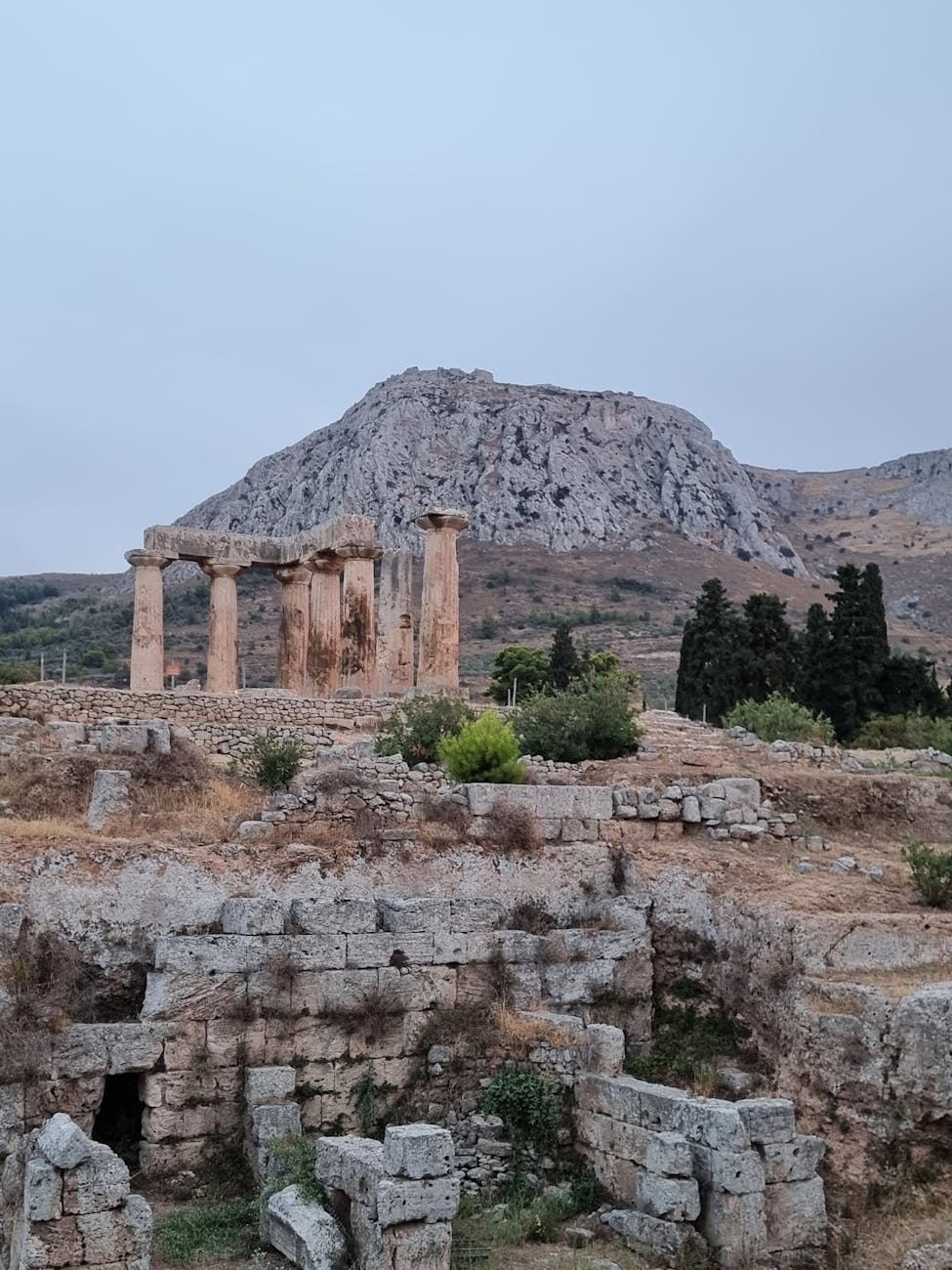
Though Corinth was a thriving and magnificent city before the Roman times, we could begin our retelling of the salient history of this site beginning with the Roman conquest of the location in 146 BC. For the following century, the city lay in ruins, but in 46 BC, Julius Caesar moved a mixed group of Italians and Greeks into the area and once again, the city rose and grew into its own thriving culture. The city was supplied with an underground well, and marble temples began to dot the landscape. The city soon became known for its luxurious culture and for its vice.
In the year 1896, The American School of Classical Studies excavated the site of the ancient city and discovered not only the bema seat where Paul appeared before Gallio (Acts 18:12-17), but they also discovered the “synagogue of the Hebrews” inscribed in stone, thus marking the site of where Paul likely ministered when he first came to Corinth. The Isthmian games were also marked off by every four years and included the boxing and running to which Paul refers in 1 Corinthians 9:24-26. The central religion of Corinth was the veneration of the goddess Aphrodite, or Venus in Latin, who was the goddess of love and fertility. The central aspect of this worship was the use of over one thousand temple prostitutes on the Acrocorinth, or the geographical high point where the people worshiped at the temple. Moral degradation even outside of this was rampant in the city.
Regardless, Paul came with a shocking message of hope in a Jewish Messiah, which was outlandish enough, but when it fell on his recipients’ ears that this was a crucified Jewish Messiah, Paul could have already be rode out of town as a fool for less. No one would have considered that anyone who had been crucified would be worthy of anything other than scorn and contempt having died a death that was meant for slaves and criminals. Now to cap all this off, Paul asserted that this crucified Lord had been physically resurrected. No one in their right mind wanted to be resurrected from the dead because the body was lowly and unwholesome. Platonic philosophy had enlightened all Greaco-Roman culture that the body needed to be left behind forever and the spirit continue to the ideal. However, Paul was completely expectant of his complete rejection on the one hand, but on the other hand, there were always those to whom his outrageous gospel was the exact medicine that they needed.
One outlook among a number of conservative teachers is that Paul conducted the bulk of his ministry to the Corinthians in his third missionary journey not excepting his founding of the church during his previous missionary journey. One outline for Paul’s interactions and letters to the Corinthians can be pieced together from just two such conservative references such as Professor Bashoor’s “Visual Outline charts of the New Testament” as well as Dr. Polhill’s book called “Paul and His Letters.” Other scholars could be referenced who basically agree as well such as F.F. Bruce and N.T. Wright.
The Church in Corinth
In the fall of AD 50 or in the spring of AD 52, the church in Corinth is founded during Paul’s second missionary journey. Then in possibly AD 55, on Paul’s third missionary journey after returning to Antioch of the Orontes, bad news reaches Paul, and he responds to them with a letter in possibly AD 55, which is inferred from 1 Corinthians 5:9-13. From this point on, his relationship with the Corinthians seems to worsen. This previous letter that he mentions is lost to us now. However, following this in the Spring of AD 56, Paul receives a reply from the church in Corinth with additional questions. In response, Paul writes 1 Corinthians in the same spring of AD 56.
At this time, Paul is in Ephesus across the Aegean Sea ministering there. Within this same timeframe, Paul makes a painful visit to Corinth, which is implied in 2 Corinthians 2:1. It is believed by some scholars that he was possibly accosted and resisted by the immoral young man, inferred from the affront described, as being received from an individual within the church according to 2 Corinthians 2:1-11. According to 2 Corinthians 7:9-12, Paul seems to have been more hurt by the reticence of the church to rebuke the person in question than by the person himself. Also in this same season of AD 56, i.e. spring time, he writes another harsh letter to follow up after he had returned immediately to Ephesus after being confronted and rejected in Corinth.
Actually, whether or not he returned to Ephesus directly by sailing back across the Aegean is unclear. He could have traveled by land back through Macedonia making a big loop and then to Ephesus. It all relies on the way that a person might view 2 Corinthians 1:15-16. Then, in the Summer of AD 56, Paul spends an anxious summer in Troas and Macedonia. Then later that summer or possibly in the fall of this same year, he writes 2 Corinthians. Lastly, Paul pays a final visit to Corinth in the winter of AD 56 or 57.
Paul’s Purpose for Writing the Book
It would seem that with Paul’s focus in 2 Corinthians on the legitimacy of his apostolic calling and credentials that the Corinthians had come to believe that his claim to that office was illegitimate. He needed to confirm his calling to them and prove that he was who he said he was. One of their accusations seems to be that Paul was not a true apostle because he suffered, and it may be inferred that since they were believing that the kingdom age had already come, that this verified that Paul was not a true apostle. If the kingdom of God had come, then there should not be anymore suffering. Paul rather boasted in his sufferings according to 2 Corinthians 11:16-33 thus corroborating the fact that the kingdom age had not yet come.
Likewise the Oxford Dictionary of the Christian Church states:
In 2 Cor. the principal topic is apostleship, negatively defined in chs. 10–13, positively in 2:14–7:4. Paul’s own status as an *apostle had been challenged and his conduct attacked. In the earlier chapters he defends his conduct, setting out at length the authority and ministry of the Christian apostle, which is derived from Christ’s New *Covenant, far superior to the *Torah and the Old Covenant of Sinai in both glory and efficacy, in that it effects the reconciliation of humanity with God by the atoning death of Christ (3:4–6:10). He rejoices that he and the Corinthians are now one again (7:8 ff).
Paul is actually rejoicing as to the fact that the Corinthians and himself are one again. He rejoices over them and considers them his own. This is a new tone. At the same time, he is attacking their questions as to his legitimacy as an apostle. It could be that not all the Corinthians were one on this issue. It could be that Paul could rejoice over a good number of them and yet address the concerns of the rest of them. All in all, it is likely that there was a mixture of views and parties within the congregation. Paul addressed their questions and kept it positive by rejoicing over all of them regardless of some of their questions.
A Discussion of the structure of the book, mentioning different viewpoints
The structure of 2 Corinthians can be listed as follows. This is taken from the New Bible Dictionary, 3rd Edition:
a. Greetings and prayer of thanksgiving (1:1–7).
b. Explanations for Paul’s apparently inconsistent behaviour (1:8–2:13): Paul gives an account of what he has experienced of suffering and the accompanying comfort of God (1:8–11); and explains that his changes of plan were made in good faith and for the benefit of the Corinthians themselves (1:12–2:13).
c. Not our glory, but God’s (2:14–4:12):
(i) A paean of praise for victory in Christ (2:14–17).
(ii) The glory of the new covenant (3:1–4:6): Paul is commending not himself (3:1–6) but the glorious covenant of the Spirit (3:7–11) which enables him boldly but in transparent honesty to proclaim the gospel (3:12–4:6).
(iii) A comparison between the treasure of the gospel and the vessel in which it is carried (4:7–12).
d. The basis of Paul’s confidence (4:13–5:10): Paul’s confidence is in the God who can raise the dead, so that even the prospect of death cannot diminish this confidence.
e. The motivation of the apostle (5:11–21):
(i) The love of Christ (5:11–15).
(ii) The good news of reconciliation (5:16–21).
f. An appeal for a response (6:1–7:4):
(i) For a positive response to Paul himself (6:1–13; 7:2–4).
(ii) For purity in the life of the church (6:14–7:1).
g. Paul’s joy and confidence in his Corinthian church (7:5–16): his letter has had its effect (7:5–13) and Paul’s trust in the church has been vindicated (7:14–16).
h. The collection (8:1–9:15):
(i) A tactful reminder that the Corinthians have not yet fulfilled their original offer of financial aid (8:1–7).
(ii) The basis of Christian giving (8:8–15).
(iii) Titus’ zeal in this service (8:16–24).
(iv) Encouragement to the Corinthians to vindicate Paul’s boast (9:1–15).
i. Warning against false apostles (10:1–13:10):
(i) An appeal for complete obedience (10:1–6).
(ii) Paul’s challenge to the troublemakers (10:7–18): he does not really need to defend his authority in Corinth, since he was the first to bring the gospel there; but these men are boasting ‘in other men’s labours’ (10:15).
(iii) Paul’s own credentials (11:1–12:13): if the Corinthians are determined to have them, Paul’s credentials are as good as any other man’s (11:1–29); but he would rather boast in his weakness, not his strengths (11:30–12:10). Yet this is all folly; the only fact of any significance is that the church experienced the true signs of an apostle (12:11–13).
(iv) Paul’s defence against the charge of defrauding the church (12:14–18): perhaps in the face of an accusation that the moneys for the collection had found their way into Paul’s own pocket.
(v) Paul’s ultimate concern (12:19–13:10): not that his own name might be cleared, but that his beloved church might improve and be built up.
j. Closing greetings (13:11–14).
Dr. Bashoor in his outline, synthesized the different aspects of the outline better in regards to their overall viewpoint in my opinion. The ones that I saw in prominent Bible Dictionaries were good, but I feel like Dr. Bashoor’s were easier to follow not only because of the visual charts, but because it was broken down in bigger chunks, so to speak, or bigger themes that encompassed the basic sections.
For example, he breaks down the letter into an introduction and conclusion. In between these there is a section dealing with “answering concerns about Paul’s ministry in 1:12-7:16, then inserting an “appeal for the Jerusalem fund” in 8:1-9:15, and lastly, there is a response to “accusations by rebellious church leaders” in 10:1-13:10. This very basic, broad outline helps to encapsulate all the details expounded in many other outlines that tend to be fairly similar but less all-encompassing in their central themes before they break things down into details.
A Synthesis of the argument of the book, going section by section through the epistle
His introduction in 1:1-11 is personal and updates the Corinthians on his struggles in the gospel and the rewards of it. It is an appropriate introduction given his personal defense of his apostleship. He is detailing his recent history in ministry and greeting his audience personally. He also talks about overcoming a great affliction in Asia. However, his suffering is a theme and key aspect of all this.
Paul then flows into his itinerary and plans for coming to the Corinthians. He will be delayed but still plans on coming. Then he addresses the need to resolve the issue of the flagrant sin of the young man in question who is with his father’s wife. He then reports his burden over the Corinthians of late and his desires for them.
At the same time, Paul waxes about the glories of the gospel ministry and his commissioning and honor in carrying it out as well as his desire for their reconciliation. Then, there is a contrast with what follows in 7:5-16 where Paul describes a recent report by Titus and his joy at their repentance. At this point there is a transition. Paul goes on about his renewed confidence in them and then puts in a word about the need for this Jerusalem fund that he is raising for that church in 8:1-9:15. Once this interlude is complete, he moves on to the next big section in which he responds to accusations made by these “false apostles.” Therein, Paul talks about his unhappy credentials as one who suffers for the sake of the ministry. He boasts in his afflictions as the marks of his legitimacy in contrast to the apparent boastings of the Corinthians in their comforts and successes.
Paul then addresses the need for the gathering of relief funds for the Jerusalem church, saying that it is not a ploy in which Paul is only aggrandizing his own wealth. He is in it for the ministry of the church. He also warns of coming confrontations with these false leaders. Paul closes in the thirteenth chapter and gives concluding remarks and greetings.
A Modern-Day Theological Challenge
If a person were to pick one major theological challenge that is a hot button topic today, one of the first that we would take on could be the doctrine of imputation as found in 2 Corinthians 5:21. NT Wright argues that the New Testament never teaches “double imputation” or the doctrine that not only is my sin imputed to Christ on the cross, but his righteousness is imputed to me as a result. Wright argues that this understanding of imputation is not an idea that Paul the Apostle would recognize.
2 Corinthians 2:14-6:13 is a long defense of Paul’s office of Apostleship according to Wright. He argues that Paul uses a basic three-point, two pronged attack at each point in this section that leads to a different conclusion than that of the traditional reformed perspective. In 2 Corinthians 5:15, he says essentially that A.) Christ died for all and secondly that B.) we live for him who died and was raised. Then shortly after this in 2 Corinthians 5:18, he argues that Paul says again of his apostleship that A.) God reconciled us to himself in the Messiah and that B.) God entrusted to us the ministry of reconciliation. So, a person is intended to see that in these successive times, the two prongs are that God did something salvifically for us, i.e. the Apostles, and we are to do something for him as a result. Then, NT Wright comes to 2 Corinthians 5:19 and argues that Paul does this same thing again saying that Paul says A.) that God was in the Messiah, reconciling the world to himself, not counting their trespasses against them; and B.) entrusting to us the ministry of reconciliation.
Finally, Wright takes the reader into the text in question, 2 Corinthians 5:21 and says that it says the same thing about Apostleship and Apostles that A.) The one who knew no sin, God made sin for us and B.) that in Him, we might become the righteousness of God. He says that in Christ, Paul the Apostle is representing the righteousness of God to the world and His covenant faithfulness as an Apostle.
One key aspect to Wright’s understanding in general is that he defines God’s righteousness as his covenant faithfulness through time. In contrast to this, John Piper – who answers Wright in his book The Future of Justification, asserts that the righteousness of God is God’s commitment to His own glory. I myself feel at this point in my studies that both of these scholars get it somewhat wrong. I have believed that both of these men make some good points in answering each other, but I would never say that God’s righteousness can be narrowly defined in either of these ways, even though both of these scholars acknowledge in each others’ definitions that they each share elements of truth in defining God’s righteousness respectively.
There is not enough space on this paper to go into all the details of their arguments, but I believe that Piper makes a very good point that Paul does seem to make some theological asides in his writing, and that the immediate context and call to “be reconciled to God” in verse 20 immediately before the verse in question has some real impacct for what the soteriological bent of how verse 21 should be understood. In fact it is a bold declaration of the imputation of the righteousness of God.
NT Wright is likely believing that Paul’s logic is too linear and sociological in impact. John Piper, while espousing something without the refined exegetical logic of NT Wright and having more of a theological/philosophical bent, does get it right at this and many other points in his book. God’s righteousness is imputed to our account.
Conclusion
The theological considerations of 2 Corinthians are mostly practical. The book gives the modern reader more insights into Corinthian culture at the time than any other resources that we possess. It also gives us more personal insights into Paul than many other books of the New Testament. On the one hand, the Corinthians were a source of great strife and anxiety for Paul as a pastor, so much so that it has been argued that Paul’s thorn in the flesh was actually the Corinthians. On the other hand, the Bible student sees the concern and desire Paul has to see the Corinthian church be secure and in Christ. He focused a great deal of effort on making several trips to them and writing four letters in an effort to see this through. He had established the church, and he wanted them to be mature in Christ. This book of the Bible should be read because it provides rich reflections on ministry and the life of God’s servant.
Bibliography
Bashoor, M. Scott. Visual Outline Charts of the New Testament. Special Print Edition, 2017
Cross, F. L., & Livingstone, E. A. Eds. The Oxford dictionary of the Christian Church 3rd Ed. Revised. New York: Oxford University Press, 2005
De Lacey, D. R. . Corinthians, Epistles to The. In D. R. W. Wood, I. H. Marshall, A. R. Millard, J. I. Packer, & D. J. Wiseman (Eds.), New Bible dictionary 3rd Edition. Leicester, England; Downers Grove, IL: InterVarsity Press, 1996
Elwell, W. A., & Beitzel, B. J. Corinth. In Baker encyclopedia of the Bible. Grand Rapids, MI: Baker Book House, 1988
Pate, C. M. Corinthians, First and Second, Theology Of. In Evangelical dictionary of biblical theology. Grand Rapids: Baker Book House, 1996
Piper, John. The Future of Justification: A Response to NT Wright. Crossway Books: Wheaton, Ill, 2007
Polhill, John B. Paul and His Letters. Broadman and Holman Publishers, Nashville, TN: 1999
Wright, N.T. Justification: God’s Plan and Paul’s Vision. Downer’s Grove, Ill: Intervarsity Press, 2009
Wright, N.T. Paul: A Biography. HarperCollins Publishers: San Francisco, CA, 2018






Leave a Reply