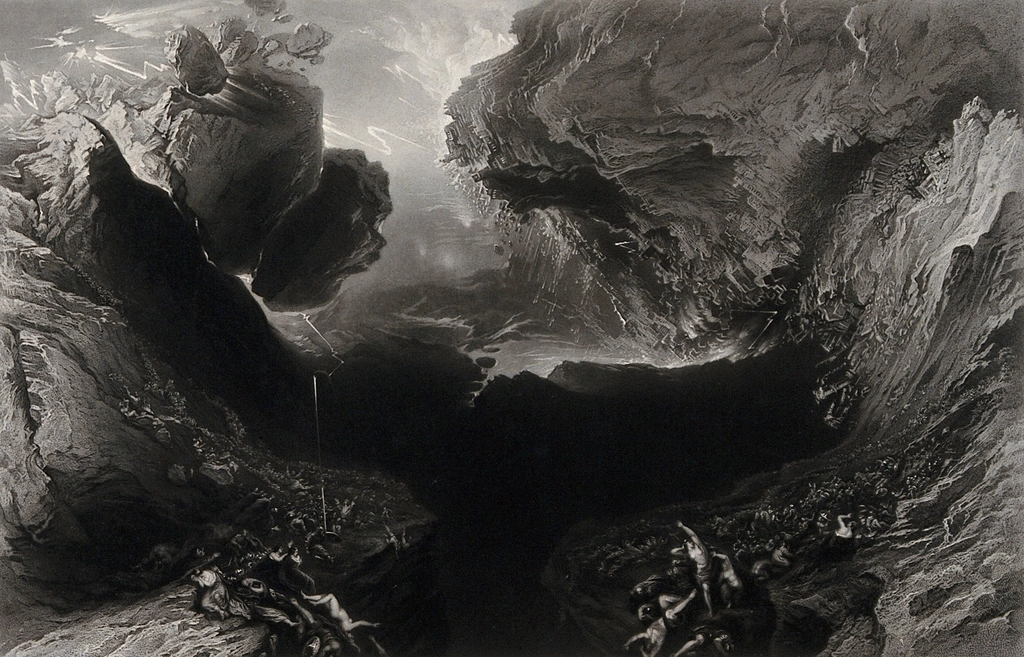
We will break down Isaiah 24-25 into the following four categories based on certain themes:
- Isaiah 24:1-20 – Global Day-of-the-Lord Judgement
Isaiah 24-25 begins…
See, the Lord is going to lay waste the earth
and devastate it;
he will ruin its face
and scatter its inhabitants—
2 it will be the same
for priest as for people,
for the master as for his servant,
for the mistress as for her servant,
for seller as for buyer,
for borrower as for lender,
for debtor as for creditor.
3 The earth will be completely laid waste
and totally plundered.
The Lord has spoken this word.Isaiah 24:1-3 NIV
“Day of the Lord” is not specifically mentioned like it is in chapter 13 of Isaiah, but it is clearly referenced here. Dr. Motyer suggests that there are intertextual parallels with Noah’s flood in Genesis, which is all the more reason to see that this is a global judgement:
We can discover the meaning of this passage through its structure. It begins and ends on the theme of the devastated earth (1–3, 18e–20); the withering of the world in verses 4–6 is balanced by the wasting individual in 16c–18d; and at the centre the song that is stilled (7–12) matches the song that is heard (13–16b). The background to the whole passage is found in the flood narrative in Genesis 6–9. Both passages refer to the ‘windows’ of heaven (floodgates, 18c; Gen. 7:11) and to the everlasting covenant (5; Gen. 9:16); the curse (6) in the context of the ‘vine’ theme (7) looks back to Noah the vinedresser and to the postdiluvian curse (Gen. 9:20ff.). Isaiah is forecasting a divine visitation on the same world scale, obliterating an old order because of its sin. In a broader but deeply significant way the contraction from the devastation of the world (1) to the downfall of the city (10) reflects the movement from the universalism of Genesis 9:19 to the particularism of the city-building of Genesis 11:1–9, linked by the motif-word ‘scattering’. The sin at Shinar was humankind turning to humankind for security and community. The new technology of bricks and mortar put into people’s hands the means of their own salvation: they could create community and safety, and curb their perceived tendency to scatter by living within a wall of their own making. The city, therefore, is the human attempt to impose order and create security without reference to God. As Isaiah sees the End, this fever of self-salvation will be worldwide, and the whole earth (1) will be as it were a global city (10). As at Shinar in the beginning, and throughout human history, this is the point at which the Lord says a decisive ‘No’ and comes in judgment. There is another link also with the flood background: at the time of that judgment, grace isolated Noah and his family (Gen. 6:8); so also, at the End, the truly deathly silence of the fallen city (8–10) is broken by song (13–16b), the song of the remnant (13). Thus this opening element in the five-part cantata matches its opening predecessors in the earlier series, not only in the Babylon-city theme (13:1–14:27; 21:1–10), but also in the great truth that the Lord in wrath remembers mercy, so organizing the world, its history and its destiny as to save and secure his own people (14:1–2; 21:10).
J. Alec Motyer, Isaiah: An Introduction and Commentary, vol. 20, Tyndale Old Testament Commentaries (Downers Grove, IL: InterVarsity Press, 1999), 183–184.
It goes without saying, but I personally do not know of a translation other than the KJV (but only in verse 3 – not in verse 1) that takes the Hebrew word used here for “earth” (eretz) and translates it “land,” which certain eschatologies would prefer it be translated because of how clearly this apocalypse in Isaiah sounds so much like the tribulation period that scholars of my persuasion say is the literal interpretation of Revelation. There are earthquakes mentioned that are also mentioned in the book of Revelation. But see 2 Thess. 2; 2 Peter 3; and Rev. 6-18 for more expectation of global judgement and the state of the world at that time.
2. Isaiah 24:21-22 – Punishment of Kings of the Earth and Evil Spiritual Beings
In that day the Lord will punish
the powers in the heavens above
and the kings on the earth below.
They will be herded together
like prisoners bound in a dungeon;
they will be shut up in prison
and be punished after many days.Isaiah 24:21-22 NIV
It says that they will all be gathered together and imprisoned. And after many days, they will be punished. This is in fact similar to Rev. 20 and the outcome for Satan who will be bound (which clearly he is not currently bound in any way if you watch the news or experience life in general).
3. Isaiah 24:23 – The Lord reigning from Mount Zion/ Jerusalem
The moon will be dismayed,
the sun ashamed;
for the Lord Almighty will reign
on Mount Zion and in Jerusalem,
and before its elders—with great glory.
So, it appears fairly straight-forward in Isaiah 24:23 that Jerusalem is where the Lord Almighty will physically reign, and that can be non other than Jesus who is God incarnate. And it connects His “glorious throne” (“with great glory” in the Isaiah) with the city of Jerusalem itself (see my blogpost on the Davidic throne here).
4. Isaiah 25:6-12 – Kingdom banquet celebration
Ahead of this section quoted below, there is a hymn of praise, then…
On this mountain the Lord Almighty will prepare
a feast of rich food for all peoples,
a banquet of aged wine—
the best of meats and the finest of wines.
7 On this mountain he will destroy
the shroud that enfolds all peoples,
the sheet that covers all nations;
8 he will swallow up death forever.
The Sovereign Lord will wipe away the tears
from all faces;
he will remove his people’s disgrace
from all the earth.
The Lord has spoken.9 In that day they will say,
“Surely this is our God;
we trusted in him, and he saved us.
This is the Lord, we trusted in him;
let us rejoice and be glad in his salvation.”10 The hand of the Lord will rest on this mountain;
but Moab will be trampled in their land
as straw is trampled down in the manure.
11 They will stretch out their hands in it,
as swimmers stretch out their hands to swim.
God will bring down their pride
despite the cleverness[a] of their hands.
12 He will bring down your high fortified walls
and lay them low;
he will bring them down to the ground,
to the very dust.Isaiah 25:6-12 NIV
In verse 6, there will be a fellowship banquet. It also represents the peace of the time. It is a time to celebrate the true kingdom of God on earth at last. All this fits so well with the futurist interpretation of Revelation. And this illustrates why the only added information that we really glean from Revelation is the fact that His reign will last 1000 years. All this Old Testament expectation anticipates everything that is perhaps more clearly delineated in Revelation, but it is nothing new.
But let’s back up a bit. The whole reason that we don’t just spiritualize the aforementioned as fulfilled in the church somehow by a “fuller sense” of the New Testament, or say that this is an unclear passage that clear passages elucidate, is because if you read forward from the beginning to the end of the Bible and you have a basic understanding of what you are reading, then you arrive at a Dispensational conclusion. You don’t read back the New Testament as a higher or clearer authority. That is simply not an accurate reading in my humble opinion. We need to take each book on its own basis and interpret each passage in light of the book in which it was written, and in the end, that does harmonize with the whole of the biblical narrative. God didn’t speak unclearly to the ancients. Isaiah 24-25 suggests that the futurist interpretation of Revelation is in harmony with passages like the above as well as the prophecies of Zechariah and Daniel.






Leave a Reply